


Used bridge cameras for wildlife: which camera suits your needs
The longest zoom isn’t automatically the best choice for wildlife. A bridge camera sits between a point-and-shoot and a DSLR or mirrorless camera, with a fixed lens that usually offers a substantial zoom range. Choosing the best used bridge camera for wildlife photography means balancing reach with handling, image quality and how you’ll use it in the field.
For distant birds, a bridge camera’s built-in zoom can be appealing. An interchangeable-lens camera lets you change lenses as your needs develop. Both have trade-offs, especially in poor light or when wildlife moves quickly. This guide explains what to look for in a used bridge camera, compares bridge and interchangeable-lens options, and helps you choose for the wildlife you want to photograph.
Key Takeaways
- Compare optical zoom and equivalent focal length to judge how well a camera can frame distant wildlife.
- Consider sensor size alongside zoom: a longer reach isn’t the only factor affecting image quality, particularly in poor light.
- Balance weight and battery life against how long you’ll spend carrying and using the camera outdoors.
- Choose a bridge camera for an all-in-one fixed-lens setup, or an interchangeable-lens camera if changing lenses matters more to you.
- Match your choice to the wildlife you photograph, the light you’ll work in and whether you prioritise reach, handling or image quality.
What are bridge cameras?
A bridge camera combines a fixed lens with controls and a zoom range beyond those of a standard point-and-shoot. For wildlife, compare optical reach with handling and focus performance, not zoom figures alone.
Optical zoom and focal-length reach
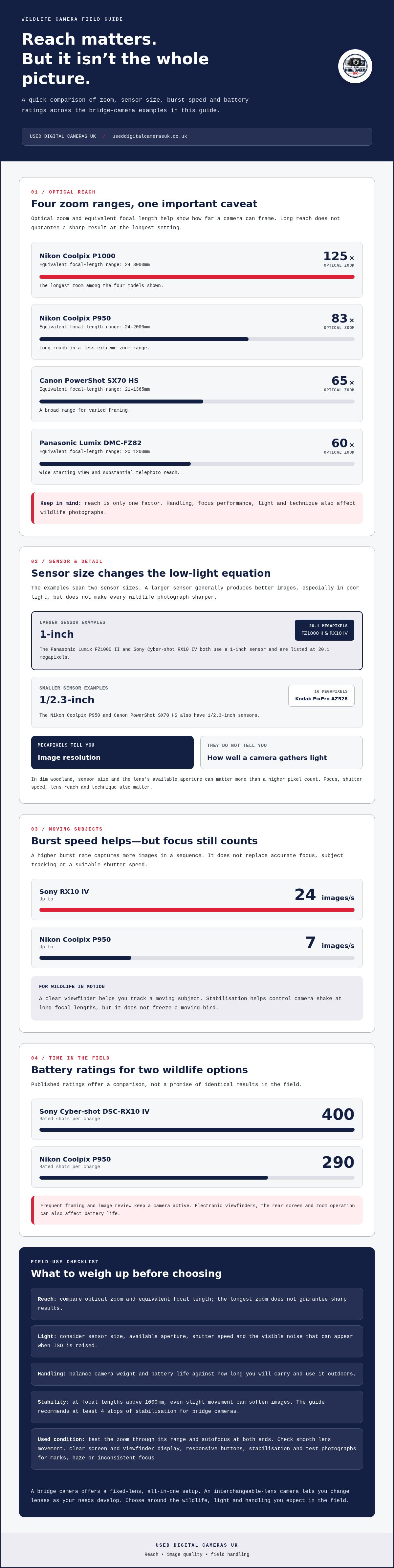
Optical zoom uses the lens to enlarge a distant subject, while equivalent focal length makes different cameras easier to compare. A Nikon Coolpix P1000 offers 125x optical zoom and a 24-3000mm equivalent range. The Canon PowerShot SX70 HS has 65x zoom, covering 21-1365mm equivalent. These figures show reach, but don’t guarantee sharp results at the longest setting.
Bridge cameras sit between point-and-shoot models and DSLR or mirrorless cameras. Their fixed lens means there’s no lens to change in the field. Smartphone zoom may combine optical and digital processing, depending on the phone; digital enlargement crops or processes the image rather than extending the lens’s optical range. For distant birds, optical zoom lets you frame the subject before capture.
| Camera | Optical zoom | Equivalent focal-length range | Wildlife consideration |
|---|---|---|---|
| Nikon Coolpix P1000 | 125x | 24-3000mm | Exceptional reach for distant subjects |
| Nikon Coolpix P950 | 83x | 24-2000mm | Long reach in a less extreme zoom range |
| Canon PowerShot SX70 HS | 65x | 21-1365mm | Broad range for varied framing |
| Panasonic Lumix DMC-FZ82 | 60x | 20-1200mm | Wide starting view and substantial telephoto reach |
Used bridge camera prices depend on the model, condition and included accessories. Compare age and features alongside zoom, rather than assuming the longest range offers the best value.
Longest zoom and fastest autofocus
The Nikon Coolpix P1000 leads these examples with 125x optical zoom and a 24-3000mm equivalent range. The Nikon COOLPIX P1100 also offers a 24-3000mm optical zoom range. Zoom specifications don’t identify the fastest autofocus: focus acquisition and subject tracking are separate performance factors. For moving wildlife, test how promptly the camera focuses on a moving subject, not just how far its lens reaches.
Before buying used, extend and retract the lens through its range, then test autofocus at both ends. Check that the lens moves smoothly, the viewfinder and screen display clearly, and the buttons respond. Take test photographs to look for marks, haze or inconsistent focus. Potential faults include a sticking zoom mechanism, unreliable stabilisation or a tired battery; repair costs depend on the fault, parts and labour.
Sensor size and image quality
Sensor size influences how a bridge camera handles detail and difficult light. The Nikon Coolpix P950 and Canon PowerShot SX70 HS have 1/2.3-inch sensors, while the Panasonic Lumix FZ1000 II and Sony Cyber-shot RX10 IV use 1-inch sensors. A larger sensor generally produces better images, especially in poor light, but it doesn’t make every wildlife photograph sharper. Focus, shutter speed, lens reach and technique all matter.
For example, the Panasonic Lumix FZ1000 II has a 20.1-megapixel 1-inch sensor, and the Sony RX10 IV also has a 20.1-megapixel 1-inch sensor. The Kodak PixPro AZ528 pairs a 16-megapixel resolution with a 1/2.3-inch sensor. Megapixels describe image resolution, not how well a camera gathers light. In dim woodland, sensor size and the lens’s available aperture can matter more than a higher pixel count.
Small-sensor bridge cameras can be more challenging to use in low light. Raising ISO can help you use a faster shutter speed, but may add visible image noise. Practise photographing a stationary bird in changing light, then review the image at full size. This shows how the camera balances detail and noise before you rely on it to capture a fleeting wildlife moment.
Image stabilisation helps reduce blur from camera movement, particularly with long lenses. At focal lengths above 1000mm, even slight movement can soften images; a recommendation for bridge cameras is at least 4 stops of stabilisation. Stabilisation can steady your framing, but it doesn’t freeze a moving bird. For action, a faster shutter speed remains important, and good support helps during careful shooting.
Burst speed, viewfinder quality and stabilisation all matter. The Sony RX10 IV can shoot at up to 24 images per second, while the Nikon Coolpix P950 reaches up to 7 images per second. A clear viewfinder helps you track a moving subject, and stabilisation helps control camera shake at long focal lengths. Neither feature replaces accurate focus or a suitable shutter speed.
Choose for the photographs and travel you have in mind. A 1-inch-sensor model such as the FZ1000 II favours image quality in challenging light; a smaller-sensor camera can offer more zoom reach in a fixed-lens package. Consider how far you’ll carry it, then weigh camera size against sensor performance and stabilisation. The strongest choice is the one you can handle steadily and use confidently in the field.
Battery life and camera weight
A wildlife camera needs to be manageable on a walk and ready to capture a fleeting subject. Compare published battery ratings with the camera’s weight, then consider how you’ll carry and use it outdoors.
Battery life on wildlife outings
Battery ratings offer a useful comparison, not a promise of identical results in the field. The Sony Cyber-shot DSC-RX10 IV is rated for 400 shots per charge, while the Nikon Coolpix P950 is rated for 290. That difference matters during long sessions, especially when frequent framing and review keep the camera active.
Electronic viewfinders on bridge cameras drain batteries faster. Using the rear screen or viewfinder, reviewing images and operating the zoom can all affect battery life. Start an outing with a fully charged battery and review images only when useful. For an extended hide session, factor battery capacity into your choice alongside reach and handling.
Used cameras have a history of use, so test the battery during ordinary shooting rather than relying solely on its stated rating. Take several photographs, operate the zoom and review images. Watch for the battery indicator dropping unusually quickly. A spare battery can be useful, but base your decision on the camera’s rated shots and the way you photograph.
Weight and portability
Weight affects how readily you’ll carry a camera between locations and how steadily you can hold it. The Panasonic Lumix DC-FZ80D / FZ82D weighs 640g, compared with 1095g for the Sony Cyber-shot DSC-RX10 IV and 1415g for the Nikon Coolpix P1100. Those differences are noticeable on a long walk, particularly when carrying other wildlife essentials.
A compact camera is easier to pack, but wildlife photography also means holding it ready while waiting for a subject. Try the grip and controls in your hands, and check whether the weight feels balanced as the lens extends. A camera that’s comfortable to raise and hold steady can be more practical than a heavier model with features you rarely use.
Bridge cameras are generally lighter and easier to carry than an interchangeable-lens setup, though the camera itself can still feel substantial. For travel or walking between birdwatching locations, the 640g Panasonic offers a lighter example than the P1100. The RX10 IV sits between those models by weight, so it may suit photographers seeking a compromise between portability and a more substantial camera body.
Match your choice to the outing: compare rated shots per charge, weigh the camera you’ll carry and consider how long you’ll be shooting. A lighter model can help on a full day’s walk; a heavier body may feel comfortable when you’re working from one fixed position.
Bridge cameras compared with interchangeable-lens cameras
A bridge camera combines a fixed lens and long zoom in one body. A DSLR or mirrorless camera lets you change lenses, but that flexibility can add cost, weight and decisions when assembling a wildlife kit.
For wildlife, a bridge camera’s fixed-lens design gives you an all-in-one range from wide views to distant subjects. Interchangeable-lens models let you choose a lens for particular wildlife or lighting, and can offer stronger image quality, autofocus or tracking performance. Bridge cameras usually cost less than mirrorless or DSLR cameras, but their limited aperture range and small sensors can make low-light or fast action more challenging.
Used models can give you access to older features without paying for the newest generation. Compare a used camera’s condition, age and included accessories with a newer model’s specifications. Consider the complete setup: a bridge camera includes its lens, while an interchangeable camera may need a separate telephoto lens to frame distant birds.
The Nikon Coolpix P950 and P1100 show the trade-off between reach and handling. The P950 offers 83x optical zoom and a 24-2000mm equivalent range; the P1100 reaches 24-3000mm optically. The P1100 also has 250x dynamic digital zoom, giving an equivalent reach of 6000mm, but digital zoom is distinct from optical reach. The P950 is described as easier to carry and more comfortable to use than the P1000, a useful reminder that maximum reach isn’t the only practical measure.
How do the Panasonic Lumix FZ1000 II, Sony RX10 IV and Nikon Coolpix P950 compare for wildlife? The FZ1000 II and RX10 IV each use a 20.1-megapixel, 1-inch sensor; their zoom ranges are 25-400mm and 24-600mm equivalent respectively. The P950 has a smaller 1/2.3-inch sensor, but its 24-2000mm range gives substantially more reach for distant subjects.
For burst shooting, the RX10 IV can capture up to 24 images per second, while the P950 reaches up to 7 images per second. Those figures favour the Sony for capturing action in a sequence; the Nikon’s longer optical reach suits distant wildlife. The FZ1000 II offers a middle ground in zoom, with a 1-inch sensor shared in size with the Sony’s.
Choose a bridge camera for an all-in-one fixed-lens setup and straightforward long reach. Choose an interchangeable model if lens choice, low-light performance or tracking matters more than keeping your kit simple. When weighing the best used bridge camera for wildlife photography against a DSLR, let subject distance and shooting conditions guide your decision.
Bridge cameras for bird and wildlife photography
For UK wildlife, the Nikon Coolpix P950 is a strong all-round choice for distant birds, while the Canon PowerShot SX70 HS offers broad reach in a different zoom range. The Panasonic Lumix FZ1000 II and Sony RX10 IV suit photographers who value their 1-inch sensors alongside wildlife versatility.
Match the camera to your usual subject. Small birds high in trees demand more reach than larger mammals nearby. The Nikon Coolpix P950 combines an 83x optical zoom with a 24-2000mm equivalent range, helping frame distant subjects without changing lenses. The Canon PowerShot SX70 HS offers a 21-1365mm equivalent range, which starts wider and still reaches far. These equivalent focal lengths make the models easier to compare, but don’t guarantee detail at maximum zoom.
For image quality in changing light, consider the Panasonic Lumix FZ1000 II or Sony RX10 IV. Both have 20.1-megapixel, 1-inch sensors, larger than the 1/2.3-inch sensors in the P950 and SX70 HS. Their reach is shorter: the FZ1000 II covers 25-400mm equivalent, and the RX10 IV covers 24-600mm equivalent. This trade-off can favour nearby wildlife and lower-light shooting over very distant birds.
The Nikon Coolpix P1000 reaches 24-3000mm equivalent with 125x optical zoom, but that extreme range isn’t automatically the best wildlife feature. At long focal lengths, camera movement becomes more noticeable, and tracking a moving animal can be difficult. Bridge cameras may struggle with action and subject tracking compared with high-end mirrorless or DSLR cameras. Bird flight is particularly demanding, so practise following a moving subject before a real outing.
Make the most of a bridge camera by choosing steady conditions and using deliberate settings. For birds, low sunlight behind you can illuminate feathers; overcast light softens contrast throughout the day. Spot or centre-weighted metering can help expose the bird rather than a bright sky. Use manual controls when conditions change, and keep the subject in the viewfinder before zooming in fully.
- For maximum optical reach: compare the Nikon Coolpix P1000 and P950.
- For a broader framing range: consider the Canon PowerShot SX70 HS.
- For a 1-inch sensor: compare the Panasonic Lumix FZ1000 II and Sony RX10 IV.
The best used bridge camera for wildlife photography depends on subject distance, light and how often you photograph movement. If a Nikon’s reach suits your birdwatching, browse used Nikon digital cameras as a next step.
Used Digital Cameras UK: Used Sony Digital Cameras
Used Digital Cameras UK sells pre-owned Sony digital cameras for wildlife photographers comparing brands and features. The range also includes used Nikon, Fujifilm and Canon digital cameras, giving you several manufacturers to consider as you narrow your choice.
Each camera is tested and includes a battery, charger and memory card. UK shipping is free. These practical details matter when choosing a pre-owned camera for birdwatching or wildlife outings, where having the essentials ready is useful. Match your priorities, such as reach, sensor size and portability, to a camera that suits your photography.
Explore Used Sony Digital Cameras as a starting point, or compare the other used camera ranges. Visit Used Digital Cameras UK online to find a camera for your next wildlife outing.
Take your next wildlife shot with confidence
Before choosing, picture the wildlife you most want to photograph and where you’ll usually be shooting. A camera suited to your regular walks and subjects is more likely to become a dependable part of your kit. That practical fit is a useful way to narrow down the best used bridge camera for wildlife photography.
When you’re ready to explore pre-owned options, Used Digital Cameras UK offers Used Sony Digital Cameras, Used Nikon Digital Cameras and Used Fujifilm Digital Cameras. Compare them against your priorities, whether you want to frame distant birds, carry the camera comfortably or get the image quality you need in changing light.
Contact Used Digital Cameras UK to take the next step towards finding a camera that fits your wildlife photography. Your next memorable encounter could be closer than you think.
Frequently Asked Questions
Should I buy the new Sony RX10 V or a used RX10 IV?
Choose based on whether newer burst speed or a pre-owned option suits your priorities. The Sony RX10 V can shoot at up to 30 images per second; the RX10 IV reaches up to 24 images per second. The RX10 IV has a 20.1-megapixel, 1-inch sensor and a 24-600mm equivalent zoom range. For wildlife action, compare burst rate with the type of subjects you photograph and your budget.
The best camera for wildlife?
There’s no single best camera for every wildlife situation. For distant birds, prioritise optical reach and stabilisation; for animals in woodland, low-light image quality and autofocus matter more. A fixed-lens bridge camera keeps the lens and body together, while an interchangeable-lens camera offers more choice as your subjects change. Decide where you’ll photograph most often, then weigh reach, handling and low-light performance against that setting.
What image quality and low-light performance can wildlife photographers expect from used bridge cameras?
Expect useful detail in good light, with more visible noise and softer results as light fades or the lens reaches its longest setting. This matters on a dim woodland walk: a stationary animal may allow a slower shutter, but a moving bird needs a faster one. Review test images at full size, especially photographs taken indoors or in shade, to judge noise, focus consistency and detail for yourself.
What are typical UK used prices for popular bridge cameras for wildlife photography?
Used prices vary by model, condition, included accessories and demand. A camera with its battery, charger and memory card may offer a more complete setup than a body alone. Compare the specifications and condition of the same model, then consider whether its reach, sensor and controls suit your photography. Treat unusually low prices with care, and factor the camera’s working condition into your decision.
Where can I buy a reliable used bridge camera in the UK, and what warranty is included?
Used Digital Cameras UK sells tested pre-owned digital cameras online across the UK. Cameras include a battery, charger and memory card, and the retailer states FREE ROYAL MAIL 24 HOUR TRACKED SHIPPING, FREE RETURNS and FAST DISPATCH & DELIVERY. Free returns and warranty cover are different things. Read the purchase terms for warranty details, and don’t assume a returns policy provides warranty protection.
Are bridge cameras suitable for photographing birds in flight and distant wildlife?
Bridge cameras can frame distant wildlife with their built-in zoom, but birds in flight are more challenging because fast movement tests autofocus and tracking. Practise following a moving bird before taking photographs, and use burst shooting to capture a sequence. For distant subjects, stabilisation can help reduce blur from camera movement, but it won’t freeze the bird. Good light, steady panning and accurate focus can all improve your chances.